
Branded Commerce
Branded Commerce is a white-labeled commerce solution: pages are Firmly-hosted under the partner’s own domain. The partner provides brand assets, DNS, ad credentials, and legal text; Firmly does the rest — pages, cart, checkout, payment, attribution. When a buyer clicks an ad promoting a product deal, they land on a Firmly-hosted, partner-branded site and complete checkout without ever leaving the partner’s domain. The merchant’s order management system receives the order as if a customer had placed it on the merchant’s own storefront.
The buyer never leaves the partner’s domain. The merchant remains the seller and the order lands in their existing platform — Firmly’s role is the cart, checkout, payment, and attribution plumbing in between.
Who this is for
Branded Commerce is built for partners whose business is driving deal traffic to checkout — without owning the commerce stack:
- Affiliate networks and deal publishers
- Retail-media networks running sponsored-product ads
- Ad networks placing product-deal creative
- Social commerce platforms surfacing influencer deals
- Editorial / content sites with embedded product links
The partner shapes the buyer-facing identity. Firmly powers everything underneath — catalog, cart, checkout, payment, attribution.
How it fits together
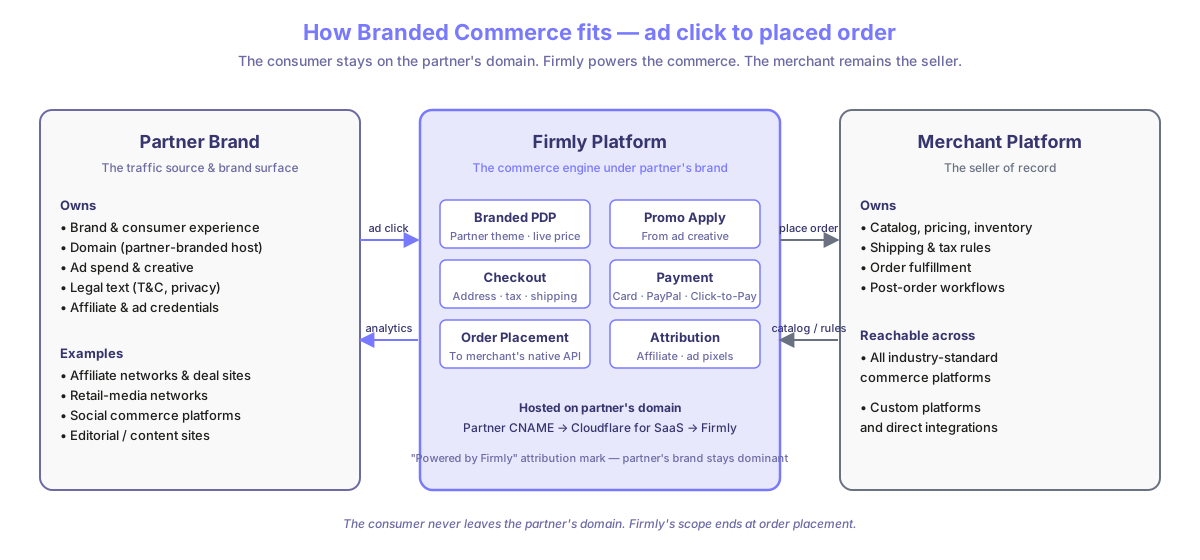
Who does what
The broad split. For the full responsibility matrix see Why Firmly → Who owns what.
| Area | Partner | Firmly | Merchant |
|---|---|---|---|
| Brand, design, and buyer experience | ✓ | — | — |
| Catalog, cart, checkout, payment | — | ✓ | Catalog source + receives the order |
| Affiliate + ad-platform attribution | Credentials (BYO or delegated) | Executes | — |
| Legal text (T&C, privacy, disclaimers) | ✓ | Renders | Merchant T&C displayed alongside |
| Everything after order placement | — | — | ✓ |
What the buyer experiences
A distraction-free ad-to-checkout path: from ad click to order in a few taps, without leaving the partner’s domain.
- Ad creative messaging carries forward through every step — PDP, checkout, thank-you page — so the deal context is never lost
- No merchant site navigation, no account creation
- Express wallets (Click to Pay, PayPal) alongside standard card entry
- Promo code from the ad is auto-applied and visible on every screen
- A clear merchant identity callout (“Shopping with [Merchant]”) so the buyer knows who they’re buying from
- A small “Powered by Firmly” attribution mark acknowledges the commerce engine behind the experience — the partner’s brand stays dominant
What the partner gets
- A fully white-labeled commerce experience under their domain, logo, colors, and fonts — buyers never see Firmly’s brand (apart from the “Powered by Firmly” attribution)
- Automatic affiliate attribution (BYO or Firmly-managed)
- Engagement analytics
- PCI scope handled entirely on Firmly’s side
- Editorial content layered on top of merchant product data — promoting a specific product, a new product line, or a curated collection tailored to a campaign
What the merchant gets
Incremental sales from deal-driven ad traffic. Orders are placed on the merchant platform as if they happened on the merchant’s own website. Existing affiliate commissions flow unchanged. No merchant-side integration required beyond being onboarded to Firmly.
Three layers of the platform
Use cases at a glance
Where to start
Related
- Branded Commerce FAQ — common partner questions, ROAS limits, multi-merchant rules
- Cart Lifecycle — how the cart progresses to a placed order
- Consent & Disclosure — pre-purchase disclosure responsibilities
- For Merchants — the merchant’s side of the integration
- Solutions overview — Branded Commerce alongside Firmly’s other solutions